
Designing OER Research: A Practical Case Study of Investigating OER and Teaching Approaches
Julie Lazzara
I. The Importance of Asking “How”: Researching Open Education’s Impact
Open educational resources (OER) are increasingly becoming a significant part of the higher education landscape. While more than half of college faculty (56%) were aware of OER, only 26% reported using OER as a required material in their courses (Seaman & Seaman, 2024). As their use expands, thoroughly understanding their effects becomes essential. It is not enough to simply track adoption rates; we need empirical research to illuminate how OER influences teaching and learning.
This chapter presents a research project that delved into the correlation between instructors’ choice of course materials (OER versus commercial textbooks) and their pedagogical approaches (teacher-focused versus student-focused). The study’s strength was enhanced by the use of a validated instrument to measure teaching approaches. Furthermore, the research incorporated a theoretical framework that had shown effectiveness in other educational research but had limited application within the specific context of OER. The primary aim of this case study is to provide a clear view of the research methodology, offering valuable insights for those interested in studying open practices.
II. Framing the Inquiry: The Relational 3P Framework
One theoretical framework that is often used to define teaching and learning is constructivism. Constructivists argue that learning is not a passive activity, but rather an active process that is influenced by context, beliefs, and attitudes (Bada & Olusegun, 2015; Bodner, 1986). For my study, I wanted to dive deeper with a conceptual framework to address how course materials might relate to teaching. That is where the Relational 3P model came in (Trigwell et al., 1999), built on Biggs’ (1993) earlier 3P model, which looked at how students approach learning.
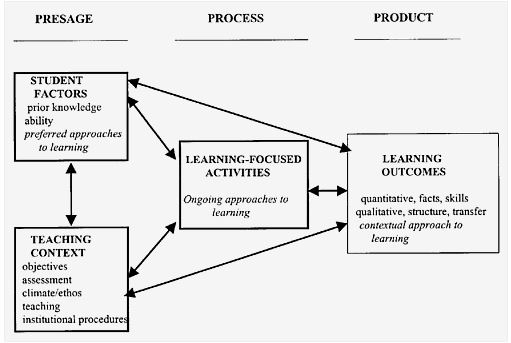
The “3Ps” stand for Presage, Process, and Product. Think of it like this: Presage factors are the things students (and, in the Relational version, teachers) bring to the learning environment, including their prior knowledge, beliefs, and even the context of the course itself. The Product is the outcome or, in other words, what students actually learn. However, the real magic happens in the Process stage, according to Trigwell and Prosser (2020). This is where the actual teaching and learning activities occur, encompassing how students engage with the material and how instructors design and deliver their courses.
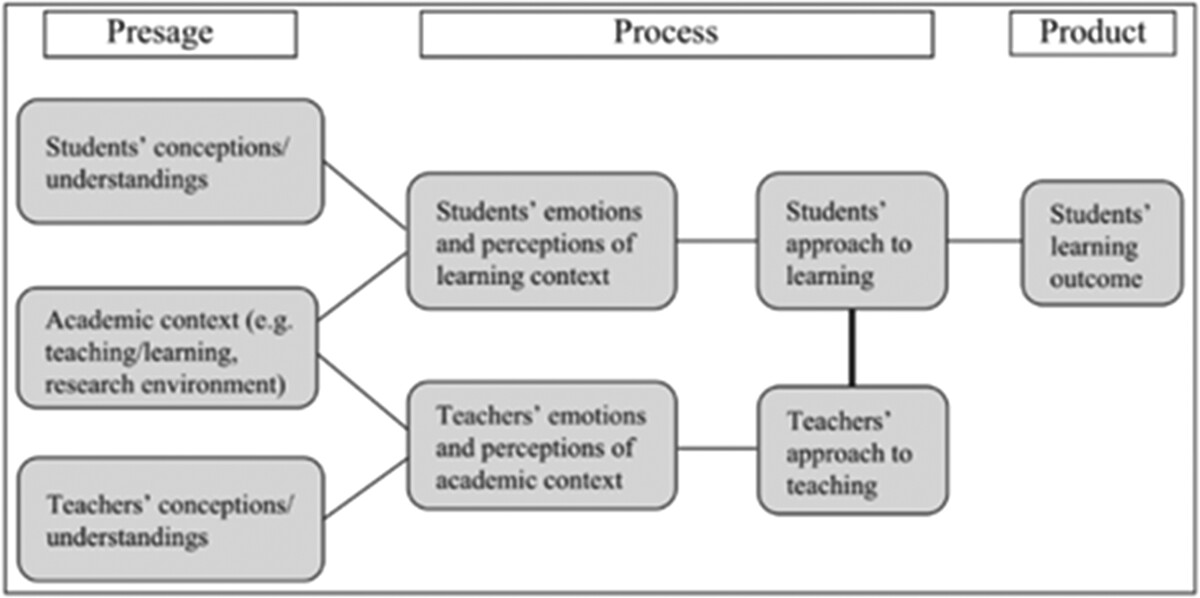
What makes the Relational 3P so valuable is that it explicitly acknowledges that teaching and learning are two sides of the same coin. I was particularly interested in its emphasis on the “process” of teaching and learning. It provided a lens through which I could explore whether the “presage” factor of choosing OER (or commercial materials) might be linked to the “process” of adopting either a more teacher-focused or student-focused pedagogy. This framework guided the formation of my research questions and the selection of my variables and instrument.
III. Laying the Groundwork: Research Methodology
This section outlines the research methodology used within this case study. This study used a quantitative comparative design, utilizing an online survey incorporating the Approaches to Teaching Inventory-Revised (ATI-R) to measure instructors’ pedagogical approaches. The research question specifically called for a comparison between these two intact groups on the measure of teaching approaches. As Schenker and Rumrill (2004) note, this type of design is well-suited for examining differences between pre-existing groups on a dependent variable. While the theoretical and anecdotal benefits of open education are often assumed (Seraphin et al., 2019), this research design aimed to provide empirical evidence to address this gap.
Finding the Participants:
I was interested in reaching a diverse group of postsecondary undergraduate instructors. Instead of just surveying faculty at my own institution, I wanted to tap into a national sample, encompassing different disciplines, institution types, and geographic locations. For recruitment, I primarily used professional development email listservs and social media groups (through Facebook and LinkedIn) related to higher education and teaching.
My thinking here was that these platforms would likely reach instructors who are actively engaged in their teaching and potentially more aware of or interested in innovative practices like using OER. However, I also recognized a potential limitation of this approach: faculty who belong to these groups might already be inherently different from those who do not. They might be more inclined towards certain pedagogical approaches or more open to new ideas.
Participant recruitment for the study was highly successful, with the target sample size achieved within a few weeks. This efficiency was attributed to several factors: the online survey was designed to be brief, respecting the time limitations of busy instructors, and a raffle with three gift card prizes was offered as an incentive for participation.
A significant consideration during recruitment was the observed imbalance in the final sample. Despite aiming for a balanced representation of instructors using OER and commercial materials, the final sample consisted of 337 participants (118 OER users and 219 commercial material users). This relatively large imbalance between groups highlights the need for targeted recruitment strategies in future research. Researchers should consider that instructors more inclined to use OER may be found within specific communities, such as open education advocacy groups, disciplines with a strong OER culture, or those who have received OER-related grants or training.
Measuring Teaching Approaches:
A handful of instruments have been designed to measure various aspects of college-level teaching. After reviewing several options, I narrowed down the instruments to the Approaches to Teaching Inventory-Revised (ATI-R) (Trigwell et al., 2005), Teacher Behaviors Checklist (TBC) (Buskist et al., 2002), Postsecondary Instructional Practices Survey (PIPS) (Walter et al., 2016), and Teacher Beliefs Survey (TBS) (Woolley et al., 2004). Ultimately, I chose the ATI-R as the instrument that best aligned with my research questions.
The ATI-R is a well-established survey designed to tap into instructors’ perceptions of their teaching practices. It has been shown to be a reliable and valid tool for differentiating between two primary approaches to teaching: the Information Transmission/Teacher-Focused (ITTF) approach and the Conceptual Change/Student-Focused (CCSF) approach.
The ATI-R presents instructors with a series of statements about their teaching and asks them to indicate their level of agreement with each statement using a Likert scale (e.g., from strongly disagree to strongly agree). The instrument comprises two main subscales, one for each of the teaching approaches I was interested in:
- Conceptual Change/Student-Focused (CCSF): This subscale includes items that reflect a focus on student learning, understanding, and active engagement. For example, a sample item is “In my interactions with students in this subject, I try to develop a conversation with them about the topics we are studying.” Instructors who score high on this subscale generally prioritize helping students develop a deeper understanding of concepts and often employ active learning strategies.
- Information Transmission/Teacher-Focused (ITTF): This subscale contains items that reflect a focus on delivering content efficiently and ensuring students have access to the necessary information. An example item includes, “In this subject, students should focus their study on what I provide them.” Higher scores on this subscale tend to indicate a more instructor-centered approach, emphasizing clear and comprehensive delivery of material. It is typically content-focused, teacher-directed, and lecture-heavy.
Using the ATI-R, I could gather quantitative data on instructors’ teaching approaches and then compare the average scores on the CCSF and ITTF subscales for the OER and commercial materials groups. This allowed me to examine whether there were any significant differences in teaching approaches based on the type of course materials used. The final results of the study revealed a statistically significant impact of course material type on student-focused instructional approaches (p = .017). Instructors using OER demonstrated a stronger inclination towards conceptual change/student-focused (CCSF) teaching than those relying on commercial materials.
While my study found that differences did exist, it did not investigate why. Does using OER impact pedagogical decision-making, or do instructors who are more student-focused in their teaching naturally gravitate towards OER? I am hopeful that future researchers will continue to investigate this further.
V. Looking Ahead: Implications and Considerations
In summary, this chapter detailed a quantitative comparative approach to OER research, highlighting methodological considerations crucial for researchers in the field. A strong emphasis was placed on the necessity of selecting a robust theoretical framework, such as the Relational 3P model, to guide the research design and interpretation of findings. The chapter further highlighted the importance of utilizing validated instruments (e.g., the ATI-R) to ensure measurement reliability and validity. Careful attention to participant recruitment strategies was also discussed, with researchers needing to address potential biases and strive for balanced sample representation. Ultimately, this case study aimed to provide valuable insights for researchers seeking to design and implement impactful studies within open education.
References
Bada, S. O., & Olusegun, S. (2015). Constructivism learning theory: A paradigm for teaching and learning. Journal of Research & Method in Education, 5(6), 66-70.
Biggs, J. (1993). From theory to practice: a cognitive systems approach. Higher Education Research and Development, 12, 73–85. https://doi.org/10.1080/0729436930120107
Bodner, G. M. (1986). Constructivism: A theory of knowledge. Journal of Chemical Education, 63(10), 873. https://doi.org/10.1021/ed063p873
Buskist, W., Sikorski, J., Buckley, T., & Saville, B. K. (2002). Elements of master teaching. In S. F. Davis & W. Buskist (Eds.), The teaching of psychology: Essays in honor of Wilbert J. McKeachie and Charles L. Brewer (pp. 27–39). Mahwah, NJ: Lawrence Erlbaum Associates, Inc. https://doi.org/10.4324/9781410603586
Lazzara, J. (2024). The connection between course materials and teaching approaches. Open Learning: The Journal of Open, Distance and e-Learning, 1–16. https://doi.org/10.1080/02680513.2024.2415323
Schenker, J. D., & Rumrill, P. D., Jr. (2004). Causal-comparative research designs. Journal of Vocational Rehabilitation, 21(3), 117-121. https://doi.org/10.3233/JVR-2004-00260
Seaman, J., & Seaman, J. (2024). Approaching a new normal? Educational resources in U.S. higher education, 2024 Bay View Analytics. https://www.bayviewanalytics.com/reports/oer_2024_new_normal.html
Trigwell, K., & Prosser, M. (2020). Exploring university teaching and learning: Experience and context. Springer Nature. https://doi.org/10.1007/978-3-030-50830-2
Trigwell, K., Prosser, M., & Ginns, P. (2005). Phenomenographic pedagogy and a revised approaches to teaching inventory. Higher Education Research & Development, 24(4), 349-360. https://doi.org/10.1080/07294360500284730
Trigwell, K., Prosser, M., & Waterhouse, F. (1999). Relations between teachers’ approaches to teaching and students’ approaches to learning. Higher Education, 37(1), 57–70. https://doi.org/10.1023/A:1003548313194
Walter, E. M., Henderson, C. R., Beach, A. L., & Williams, C. T. (2016). Introducing the Postsecondary Instructional Practices Survey (PIPS): A concise, interdisciplinary, and easy-to-score survey. CBE—Life Sciences Education, 15(4), ar53. https://doi.org/10.1187/cbe.15-09-0193
Woolley, S. L., Benjamin, W. J. J., & Woolley, A. W. (2004). Construct validity of a self-report measure of teacher beliefs related to constructivist and traditional approaches to teaching and learning. Educational and psychological measurement, 64(2), 319–331. https://doi.org/10.1177/0013164403261189
About the author

name: Julie Lazzara, PhD
institution: Chandler Gilbert Community College
website: https://www.researchgate.net/profile/Julie-Lazzara-2?ev=hdr_xprf
As a Psychology Professor at Chandler-Gilbert Community College, Dr. Lazzara’s work is centered on improving the student learning experience. Her research focuses on the scholarship of teaching and learning (SoTL), with publications exploring the impact of renewable assignments, open pedagogy, and social annotation on student success and equity. A passionate advocate for affordable education, she is an author and contributor to several Open Educational Resources (OER), including widely used psychology textbooks for OpenStax and Open Maricopa. Her scholarship appears in journals such as Open Praxis, Online Learning, and Scholarship of Teaching and Learning in Psychology.
